


Advent: four weeks leading up to Christmas
An Advent wreath, candles, a chocolate calendar… This Sunday marks the start of Advent. But what exactly is Advent? That’s quite a question!
Christmas markets are in full swing, St Nicholas’ Day is approaching, and Christmas trees are being lit up all over Luxembourg. In many homes, a wreath adorned with four candles also appears on the table. This marks the beginning of Advent.
In a nutshell
Advent is the four-week period leading up to Christmas: for Christians, it is a time to prepare to celebrate the birth of Jesus. It also marks the start of the Church year! The liturgical year – that is, the calendar of Christian festivals – does not begin on 1 January, but on the first Sunday of Advent. This year, that falls on 29 November.
A bit of history
The word comes from the Latin adventus, which means ‘arrival’ or ‘coming’. Advent is therefore the time when we await someone’s arrival.
In the 5th century, in Gaul, Christians used to prepare for Christmas… by fasting three days a week from St Martin’s Day, 11 November! It was known at the time as ‘St Martin’s Lent’. Over the centuries, the period was reduced to four weeks, and the fasting eventually disappeared.
What this means for Christians
For believers, Advent is a time of joyful anticipation. During this season, they celebrate the coming of Jesus in three ways: his birth in Bethlehem 2,000 years ago, his presence in their lives today, and his promised return at the end of time.
What we see
- The Advent wreath: every Sunday, one more candle is lit, until there are four.
- The purple of the priest’s vestments at Mass, the colour of anticipation. On the third Sunday, it may give way to pink, as a sign of joy: Christmas is just around the corner.
- The Gloria, the festive hymn of the Mass, is no longer sung on Sundays. It returns at Christmas, like a fireworks display.
- The Advent calendar, which originated in Germany in the 19th century to help children wait patiently until Christmas.
And for those who wish to
You don’t have to be a practising believer to enjoy Advent. Amidst the hustle and bustle of the festive season, these four weeks can be an invitation to slow down, find a moment of quiet and think of those we are waiting for, or who are waiting for us. Parishes across the country are also organising celebrations and concerts throughout the month. The Lefèvre Family will be performing Christmas carols on 13 December.
Did you know?
The Advent wreath has its origins in a pagan custom: at the time of the winter solstice, people would make wreaths from pine branches, the green of which symbolised life. The tradition was adapted to Christian culture. The first illuminated wreath had… 28 candles! In 1839, in Hamburg, the pastor Johann Hinrich Wichern arranged 24 medium-sized and 4 large candles on a cartwheel. This allowed the children to count down the days until Christmas. To save space, only the four candles for Sundays were subsequently retained.
Next big question: what is abstinence?
Merci, datt dir dësen Artikel gelies hutt. Falls dir wëllt iwwert d'Aktualitéite vun der Kathoulescher Kierch zu Lëtzebuerg informéiert bleiwen, dann abonnéiert Iech fir d'Cathol-News, den Newsletter, deen all Donneschdeg erauskënnt, andeems dir hei klickt.
Headlines
-
The Lefèvre family in concert in Luxembourg
On 13 December, don’t miss this chance to discover a Catholic, family-oriented and spiritual choir.
-
D’Mass um 1. Adventssonndeg gëtt vun Aasselbur iwwerdroen
D'Sonndesmass an de Medien
-
Communiqué de solidarité
Jean-Claude Cardinal Hollerich exprime sa solidarité avec Fridolin Cardinal Ambongo Besungu et Fulgence Muteba Mugalu
-
Mass for Peace on 5 December 2026
I listen: what will the Lord God say? What he says is peace for his people and his faithful ones. (Ps 84:9a)
Read more

Advent: four weeks leading up to Christmas
An Advent wreath, candles, a chocolate calendar… This Sunday marks the start of Advent. But what exactly is Advent? That’s quite a question!

Taizé European Meeting in Łódź!
Every year, the Taizé prayer movement organises a New Year’s Eve celebration for young people. Registrations close on 30 November.
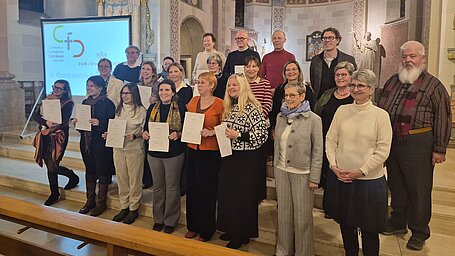
Ceremonial presentation of certificates for the ‘Kiercheguide fir Lëtzebuerg’
On 16 November 2026 in Walferdingen.
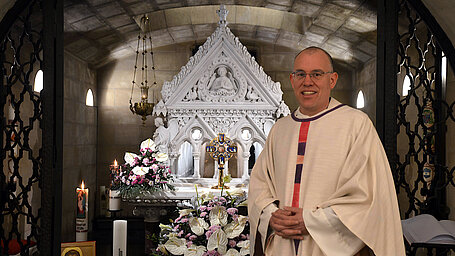
‘A spiritual interlude’
A look back at the Octave of Saint Willibrord and an interview with Father Yves Olinger, the preacher for the occasion.